Format Or Customize A Table Of Contents In Word For Mac
Word 2007 assembles a table of contents (TOC) for you by listing the headings (each with the page number) you designate throughout your document beforehand. Word takes care of counting pages, and even adjusts the TOC for you if the document’s page numbers change. When you create a TOC, Word searches your document for heading paragraphs to include in the table, recognizing them by the styles you assign to them.
1Apply heading styles to your chosen headings.
To apply a heading style, put the cursor in the chosen paragraph and then press Ctrl+Alt+1 (for Heading 1) or Ctrl+Alt+2 (for Heading 2), and so on.
In the table of contents, select two consecutive paragraphs at the same level (which means that they are using the same style), for instance those numbered 1.1 and 1.2 in your example. Press Ctrl+Shift+S to display the Apply Styles pane. Verify that you see the correct TOC styles (TOC 2 for level 2) and click the Modify button.
2Move the insertion point to the place where you want the Table of Contents to appear.
The TOC generally appears on its own page near the beginning of a document. Press Ctrl+Enter to create a new page if necessary and then click to position the insertion point on the empty page.
3Click the References tab on the Ribbon and then click the Table of Contents button found in the Table of Contents group.
A menu that lists several Table of Contents styles is displayed.
4Click the Table of Contents style you want to use.
The TOC appears in the document. Note that the shaded frame that’s drawn around the Table of Contents is visible only when you hover the cursor over the table. (This frame doesn’t appear when you print the document.) You’re done!
5To customize your TOC, click the Table of Contents button and select Insert Table of Contents Field.
This action summons the Table of contents dialog box, where you can choose options for your table:
Show Page Numbers: Deselect this check box if you want the TOC to show the document’s outline but not page numbers.
Right-Align Page Numbers: Deselect this check box if you want the page numbers placed right next to the corresponding text rather than at the right margin.
Tab Leader: Use this drop-down list to change or remove the dotted line that connects each TOC entry to its page number.
Formats: Use this drop-down list to select one of several predefined formats for the Table of Contents.
Show Levels: Use this control to specify which heading levels to include in the table.
After you create the TOC, it does not reflect later changes you make to the document unless you update (rebuild) it by following these next two steps:
6Click the Update Table button in the Table of Contents group of the References tab.
The Update Table of Contents dialog box appears. Here you can choose whether to rebuild the entire table or just update the page numbers.
7Click OK to update the table.
:max_bytes(150000):strip_icc()/003-create-table-of-contents-microsoft-word-4172941-5acbe0a22bda46e7986c30e2be419dd8.jpg "Format")
You can also update a Table of Contents by selecting the table and pressing F9. Or, you can right-click the table and choose Update Field from the shortcut menu.
Another option is to press Ctrl+A (to select the entire document) and then press F9 (to update all TOCs in the document).
8Save your file after you update the tables.
If you want to update the TOC again, repeat these steps.
1Aug 24, 2008, 11:18 AMRonex RigixĊUnit7-Complete.pdf46kv. A-level business textbook. 1Aug 24, 2008, 11:14 AMRonex RigixĊUnit6-f(AS).pdf45kv. 1Aug 24, 2008, 11:14 AMRonex RigixĊUnit6-g(A2).pdf25kv. 1Aug 24, 2008, 11:14 AMRonex RigixĊUnit7-d(A2).pdf154kv.
9To delete a TOC, select the entire table and press Delete.
Alternatively, you can click the Table of Contents button on the References tab on the Ribbon. From the menu that appears, choose Remove Table of Contents.
In Office 2011 for Mac, Word features a fast, new way to make a Table of Contents (TOC). If you’ve been using Heading styles throughout your document, the process is entirely automatic. Choose to make a Table of Contents automatically; otherwise, select the Manual Formatting option.
Follow these steps to make a TOC:
Click in the document where you want the TOC to appear.
In the Document Elements tab of the Ribbon, look in the Table of Contents group and click the tab at the bottom-center of the gallery.
Choose a TOC style from the Automatic Table of Contents group in the gallery.
* Choose Heading Styles if your document contains Heading styles.
* Choose Manual if your document does not contain Heading styles.
If you choose an Automatic option, based on the heading styles you used in the document, Word creates a quick TOC for you! If you choose the Manual option, Word guesses at your document’s structure and presents you with a generic TOC based on your format choice from the gallery that you can customize manually.
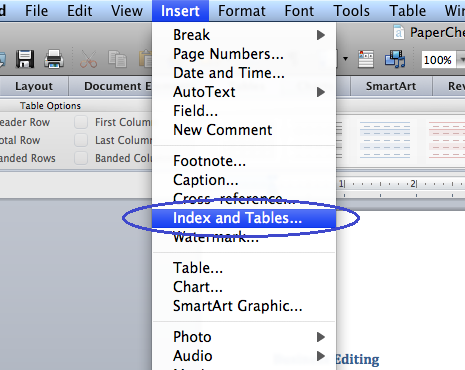
How fast and easy is that? As long as your document is well-structured based on Heading styles, Word’s TOC feature saves you a ton of work. But what if you want more TOC style choices? No problem! Select the entire TOC that you put into your document. In Word, choose Insert→Index and Tables, and then select the Table of Contents tab in the Index and Tables dialog that appears.
Here you can choose from additional formatting options:
Formats: Shows built-in and your own custom TOC format styles.
Show Levels: Sets how many heading levels will be used in the TOC.
Show Page Numbers: This check box shows or hides page numbers.
Right Align Page Numbers: This check box aligns page numbers left or right.
Tab Leader: This pop-up menu offers more choices for the type of leader line that will be inserted between headings and page numbers.
Options button: This button opens the Table of Contents Options dialog.
With the Table of Contents dialog, you can manually map styles to TOC levels by typing in TOC level values in the fields to the right of the Available Styles list. You can determine which styles to make available:
Styles: Selecting this box allows you to choose from TOC styles from Normal.dotm and other open templates.
Table Entry Fields: Select this box to allow mapping of TOC Word field codes in your document to TOC levels in a TOC.
Modify:Available if you choose From Template in the Styles list.